+86 131 0334 5630
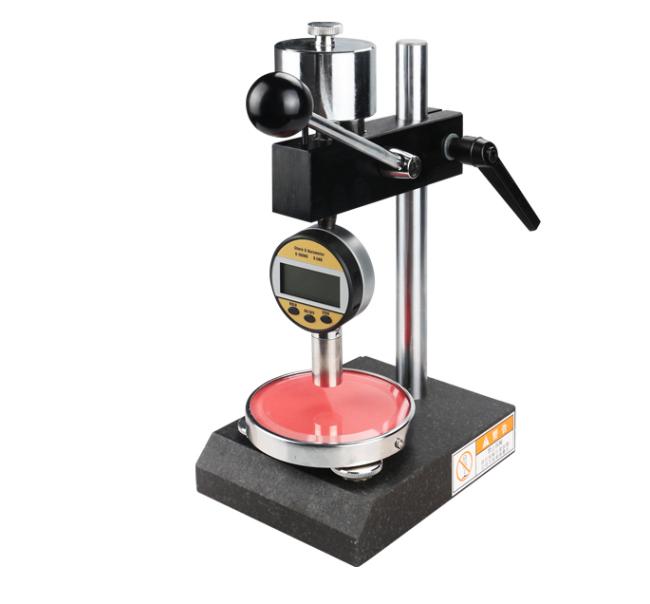
LX-A Digital Rubber Hardness Tester

LX-A Digital Rubber Hardness Tester

Model: LX-A

Measurement Range: 0-100 HA

Measurement Error: Within the range of 20-90 HA, the error is ≤ ±1 HA

Resolution: 0.1 HA

Indenter Travel: 0-2.5 mm

Force at Indenter Tip: 0.55 N - 8.05 N

Standards: ASTM D 2240

Portable digital hardness tester for vulcanized rubber and plastics. Complies with ASTM D 2240. Supports both laboratory bench testing and handheld on-site measurement of installed components.
Send Inquiry
Product details ofLX-A Digital Rubber Hardness Tester

Shore Hardness Tester: Type A vs Type D – What's the Difference?

Shore A and Shore D are the two most commonly used durometer scales for measuring the hardness of rubber and plastics. They share the same testing principle – pressing a standardized indenter into the material under a specific force and converting the indentation depth into a hardness value from 0 to 100. The difference lies in indenter geometry, applied force, and intended materials.


Parameter

Shore A (LX-A)

Shore D (LX-D)

Indenter tip

Blunt cone, ø0.79 mm 

(rounded)

Sharp cone, R0.1 mm 

(pointed)

Test force range

0.55 N – 8.06 N

0.455 N – 44.5 N

Ideal hardness range

10 – 90 HA

20 – 90 HD

Typical materials

Soft rubber, elastomers, TPE, seals, gaskets, leather, felt

Hard rubber, rigid plastics, thermoplastics, epoxy, 

acrylic, printed circuit boards

Common standards

GB/T 531, 

ASTM D2240 Type A

GB/T 531, ASTM D2240 Type D

Use case

General rubber products,

flexible seals, O-rings

Engineering plastics, hard resin, floor materials


·Use Shore A for soft to medium-hard rubber and elastic materials.

·Use Shore D for hard rubber and rigid plastics.

·Rule of thumb: If a reading exceeds 90 HA, switch to Shore D for more accurate results. If it falls below 20 HD, switch back to Shore A. Measurements near the extremes of a scale are less reliable.


FAQ – Frequently Asked Questions


Q1: What is a Shore hardness tester used for?

A Shore hardness tester measures the indentation hardness of vulcanized rubber, thermoplastic rubber, and plastics. It is widely used in quality control, material testing labs, and on-site production inspection.


Q2: What's the difference between Shore A, Shore C, and Shore D?

All three work on the same principle but use different indenter shapes and forces:

·Shore A – blunt cone tip, for soft rubber and elastomers

·Shore C – 5 mm spherical tip, for foam and sponge materials

·Shore D – sharp cone tip, for hard rubber and rigid plastics


Q3: How do I choose between Type A and Type D?

Start with Shore A for most rubber and flexible materials. If your reading is above 90 HA, the material is too hard for the A scale – switch to Shore D. Conversely, if a Shore D reading is below 20 HD, go back to Shore A for better accuracy.


Q4: Do I need a test stand or is handheld measurement okay?

Handheld testing works for quick on-site checks and large installed components. For standardized laboratory measurements or quality certification, a dedicated test stand is required to ensure consistent force application and accurate, repeatable results.


Q5: How should I prepare the sample?

·The specimen surface must be clean, smooth, and free of oil, dirt, or oxidation.

·Sample thickness should be at least 6 mm (thin samples can be stacked).

·Test at ambient temperature (20°C ± 10°C) and away from vibration.

·Take at least 3 measurements at different points and average the results.


Q6: How often should I calibrate the hardness tester?

Calibrate with a standard hardness block before each use, or at least once per shift during continuous operation. Formal metrological calibration should be performed annually or according to your quality management system requirements.


Q7: Why do my readings vary between tests?

Common causes include:

·Inconsistent pressure or tilt angle during handheld testing

·Testing too close to the sample edge (stay at least 12 mm from edges)

·Insufficient sample thickness

·Temperature differences between tests

·Surface roughness or uneven material

Using a test stand eliminates most operator-induced variation.


Q8: What standards do Shore hardness testers comply with?

Common standards include GB/T 531 (China), ASTM D2240 (USA), ISO 7619 (international), DIN 53505 (Germany), and JJG 304 (metrological verification regulation of China).


Q9: What's the difference between analog and digital Shore hardness testers?

Analog (dial) testers are simple, durable, and low-cost. Digital testers offer clearer readings, data hold function, memory storage, and PC connectivity for data logging – ideal for batch testing and quality documentation.


Product Inquiry

We use cookie to improve your online experience. By continuing to browse this website, you agree to our use of cookie.

Cookies

Please read our Terms and Conditions and this Policy before accessing or using our Services. If you cannot agree with this Policy or the Terms and Conditions, please do not access or use our Services. If you are located in a jurisdiction outside the European Economic Area, by using our Services, you accept the Terms and Conditions and accept our privacy practices described in this Policy.
We may modify this Policy at any time, without prior notice, and changes may apply to any Personal Information we already hold about you, as well as any new Personal Information collected after the Policy is modified. If we make changes, we will notify you by revising the date at the top of this Policy. We will provide you with advanced notice if we make any material changes to how we collect, use or disclose your Personal Information that impact your rights under this Policy. If you are located in a jurisdiction other than the European Economic Area, the United Kingdom or Switzerland (collectively “European Countries”), your continued access or use of our Services after receiving the notice of changes, constitutes your acknowledgement that you accept the updated Policy. In addition, we may provide you with real time disclosures or additional information about the Personal Information handling practices of specific parts of our Services. Such notices may supplement this Policy or provide you with additional choices about how we process your Personal Information.


Cookies

Cookies are small text files stored on your device when you access most Websites on the internet or open certain emails. Among other things, Cookies allow a Website to recognize your device and remember if you've been to the Website before. Examples of information collected by Cookies include your browser type and the address of the Website from which you arrived at our Website as well as IP address and clickstream behavior (that is the pages you view and the links you click).We use the term cookie to refer to Cookies and technologies that perform a similar function to Cookies (e.g., tags, pixels, web beacons, etc.). Cookies can be read by the originating Website on each subsequent visit and by any other Website that recognizes the cookie. The Website uses Cookies in order to make the Website easier to use, to support a better user experience, including the provision of information and functionality to you, as well as to provide us with information about how the Website is used so that we can make sure it is as up to date, relevant, and error free as we can. Cookies on the Website We use Cookies to personalize your experience when you visit the Site, uniquely identify your computer for security purposes, and enable us and our third-party service providers to serve ads on our behalf across the internet.

We classify Cookies in the following categories:
 ●  Strictly Necessary Cookies
 ●  Performance Cookies
 ●  Functional Cookies
 ●  Targeting Cookies


Cookie List
A cookie is a small piece of data (text file) that a website – when visited by a user – asks your browser to store on your device in order to remember information about you, such as your language preference or login information. Those cookies are set by us and called first-party cookies. We also use third-party cookies – which are cookies from a domain different than the domain of the website you are visiting – for our advertising and marketing efforts. More specifically, we use cookies and other tracking technologies for the following purposes:

Strictly Necessary Cookies
These cookies are necessary for the website to function and cannot be switched off in our systems. They are usually only set in response to actions made by you which amount to a request for services, such as setting your privacy preferences, logging in or filling in forms. You can set your browser to block or alert you about these cookies, but some parts of the site will not then work. These cookies do not store any personally identifiable information.

Functional Cookies
These cookies enable the website to provide enhanced functionality and personalisation. They may be set by us or by third party providers whose services we have added to our pages. If you do not allow these cookies then some or all of these services may not function properly.

Performance Cookies
These cookies allow us to count visits and traffic sources so we can measure and improve the performance of our site. They help us to know which pages are the most and least popular and see how visitors move around the site. All information these cookies collect is aggregated and therefore anonymous. If you do not allow these cookies we will not know when you have visited our site, and will not be able to monitor its performance.

Targeting Cookies
These cookies may be set through our site by our advertising partners. They may be used by those companies to build a profile of your interests and show you relevant adverts on other sites. They do not store directly personal information, but are based on uniquely identifying your browser and internet device. If you do not allow these cookies, you will experience less targeted advertising.

How To Turn Off Cookies
You can choose to restrict or block Cookies through your browser settings at any time. Please note that certain Cookies may be set as soon as you visit the Website, but you can remove them using your browser settings. However, please be aware that restricting or blocking Cookies set on the Website may impact the functionality or performance of the Website or prevent you from using certain services provided through the Website. It will also affect our ability to update the Website to cater for user preferences and improve performance. Cookies within Mobile Applications

We only use Strictly Necessary Cookies on our mobile applications. These Cookies are critical to the functionality of our applications, so if you block or delete these Cookies you may not be able to use the application. These Cookies are not shared with any other application on your mobile device. We never use the Cookies from the mobile application to store personal information about you.

If you have questions or concerns regarding any information in this Privacy Policy, please contact us by email at . You can also contact us via our customer service at our Site.