


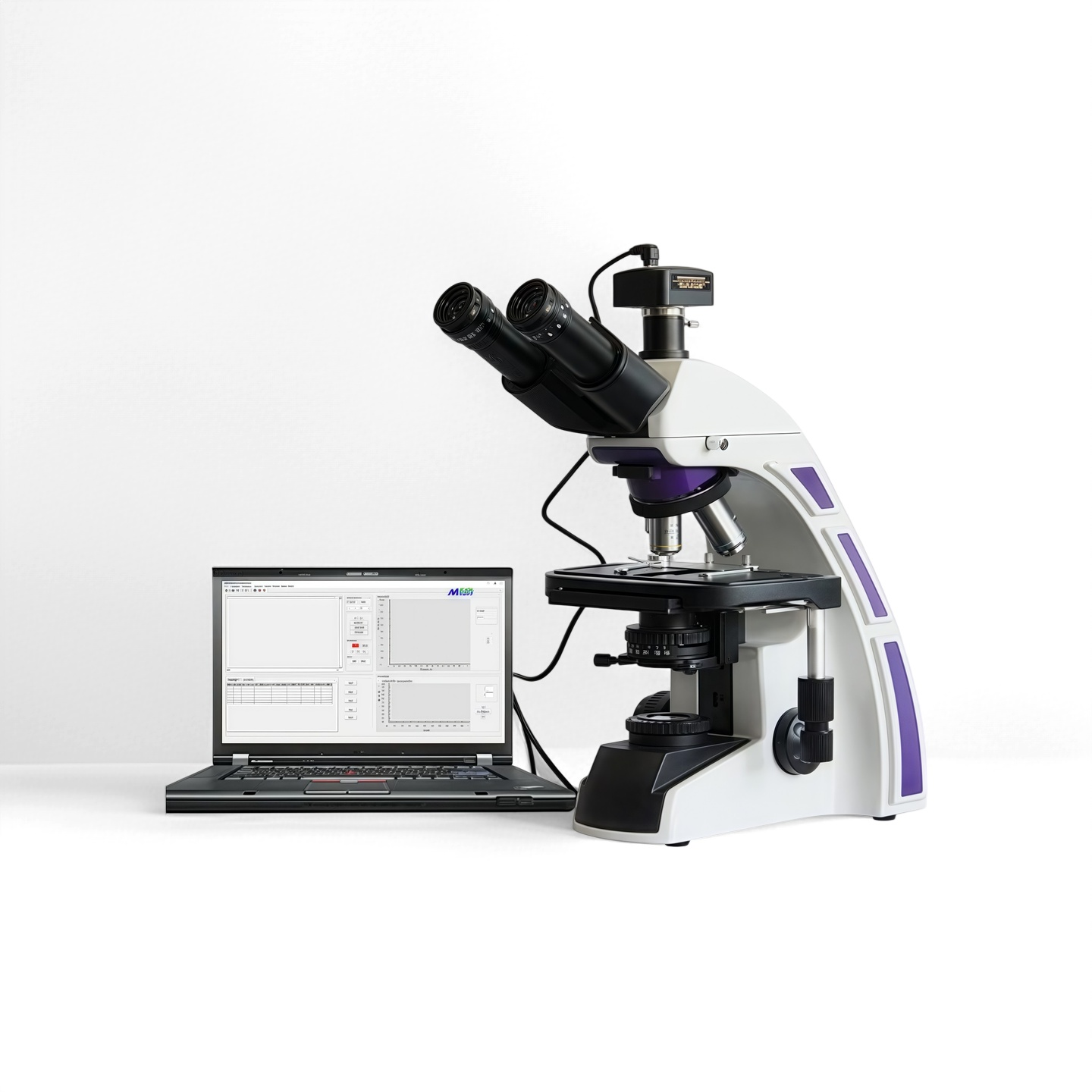
Carbon black dispersion tester
Model: SL-MP100
Magnification: 40X-1000X
Eyepiece: large field of view high eye eyepiece 10X-22mm
Infinite flat field achromatic objective: 4X / 0.1,10X / 0.25,20X / 0.40,40X / 0.65 (spring), 100X / 1.25 (spring, oil). All optical lenses were mildew resistant;
Mirror tube group: stranded chain binocular tube; 30 degrees tilt; pupil spacing 48-75mm, left tube refraction adjustable
Objective lens converter: inverted four-hole ball bearing positioning, with mildew proof device
Condenser: N.A.1. 25 Abbe concentrating mirror, double column vertical lifting mode;
Digital camera: digital camera, 5 million pixels, resolution 2048 * 1536, USB2.0 interface
Carbon black dispersion analysis software: rating according to the national standard (GB / T 18251-2019). Rating report charts can be stored or printed
Major Function
1.It can automatically analyze and rate the carbon black microscopic images according to the national standard-GB / T 18251-2019。
2.Standard scale, cross grid line can be displayed on the image。
3.The software can analyze the photographed particle images, And give the active substance number, girth, The equal circle diameter, roundness, The equal circumference diameter, Hole area, No hole area, Minimum rectangular area, Rectangular degree, Long-axis length, Long-axis direction angle, Length of the vertical long shaft, Long-axis aspect ratio, Short shaft length, Short-axis direction angle, Vertical vertical shaft length, Short-axis aspect ratio, Maximum aspect ratio, peak width, Regional height, Area aspect ratio, average diameter, Circle area rate, semi-perimeter, Field of view area, Number of contents, Content area, Percent of the content area, Number and density of contents, Number of active substances, Effective material area, Effective material area, Percent of the effective material area, Effective object number density and other 30 several parameters data. The data can be outputs and imported into the EXCEL table to number the particles of the camera and correspond to the serial number in the table one by one, and the statistical table of particle size number, statistical table of particle size area, particle size distribution table and particle size cumulative distribution table can be generated。
| Delivery time | Certificate | Whether customization is accepted | MOQ | Packaging information |
| 10 days | CE | No | 1 unit | 1 pc |
FAQ
1. What is a carbon black dispersion tester used for?
A carbon black dispersion tester is used to evaluate the uniformity of dispersion of carbon black (or pigment) particles in the matrix of polyolefin pipes, fittings, and compounds. It captures cross-sectional images of specimens using a high-power microscope, and then professional software analyzes the size, quantity, and distribution of carbon black agglomerates, ultimately providing a dispersion grade rating. It is a key piece of equipment for pipe manufacturers, plastic compounding plants, and quality control laboratories to judge product consistency.
2. Which standards does the instrument comply with?
This instrument is strictly designed in accordance with GB/T 18251-2019 "Determination of pigment or carbon black dispersion degree in polyolefin pipes, fittings and compounding materials", which is modified in relation to ISO 18553:2002. It is also applicable to the judgment requirement that the carbon black dispersion degree shall be ≤ grade 3 in factory inspection of PE100 gas pipes, water supply pipes, and similar products.
3. Which materials can be tested?
- Polyethylene (PE) pipes, fittings and compounds
- Polypropylene (PP) pipes and modified materials
- Polybutylene (PB) pipes
- Black polyolefin masterbatches
- Other thermoplastics containing carbon black/pigments
4. How are carbon black dispersion test specimens prepared, and what equipment is required?
There are two methods: the compression molding method and the microtome sectioning method.
Required equipment includes an oven, microscope slides, spring clamps, and metal spacers.
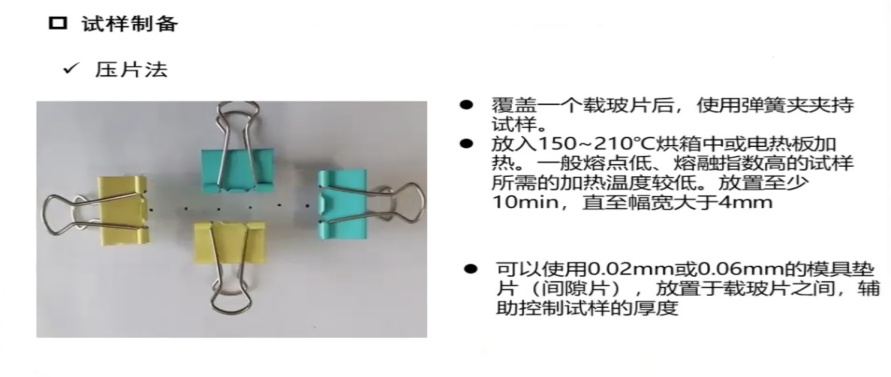
The compression molding method is commonly used. Using a scalpel, cut six specimens from different parts of the product. For pigment dispersion measurement, each specimen shall have a mass of (0.6 ± 0.2) mg. For carbon black dispersion measurement, each specimen shall have a mass of (0.2 ± 0.10) mg. Place the six specimens on one or several clean microscope slides, arranging them so that each specimen is approximately equidistant from adjacent specimens or from the edges of the slide, and cover them with another clean slide (or slides).
Spacers made of metal or other materials may be used to ensure uniform thickness of the prepared specimens. Since the specimen mass and thickness are specified, each specimen shall have a width of at least 4 mm.
Use an oven and clamp the two slides together with spring clamps. Place the clamped slides in the oven, maintaining the oven temperature at 150 °C to 210 °C, and leave them for at least 10 min until each specimen reaches the required thickness.
Remove the slides from the oven, allow them to cool, and then remove the spring clamps.
Product Inquiry